


Competitors should always be part of the focus of the Intelligence Function. But how can we...
We said in another post that if we cannot answer the question “What does my company need to monitor?”, the best approach is to break the problem into parts. We divided the overall problem into Decision Time Horizons. We noted that Tactical Intelligence deals with what is happening right now, and leads to reactive types of decisions (the first Decision Horizon).
But let’s suppose that we still do not “know what we want to know” within the Tactical Horizon. Or that we simply want to review our current Intelligence strategy. Again, it is worth breaking the problem into smaller problems. To do so, we will rely on Porter’s 5 Forces. Let’s monitor competitors, customers, suppliers, substitute products… in an organised way. A note for those who already know the 5 Forces: I have made a small change, adding Regulation or the influence of Public Administration, since we are in the EU.
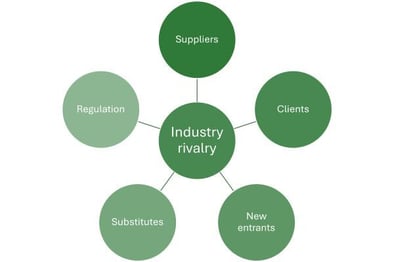
External forces put pressure on our business.
However, the strategy we are going to follow is not the simple or direct one. That is, we are not going to try to know “everything that refers to my customers”, for example. Because we would receive too much non-specific information that would be enormously costly to filter manually… Unless we recklessly reduce the number of information sources, which is a ticket to an overly risky future: it implies drastically reducing the universe under watch and driving the company almost blind, simply because of our lack of precision about what we really need.
The strategy we will follow will be the combination of “simple” targets from each of the Forces. Let’s look at some examples:
-
Suppliers + Competitors: We should monitor when a supplier (not necessarily an innovation supplier, but also especially), collaborates at the same time with a key competitor. Let’s recall some ideas about counter-intelligence.
-
Suppliers + Technology: We can monitor news from any of our suppliers about production technology that is key for us. Including patent applications. It may be interesting to offer ourselves as guinea pigs for a promising advance, in exchange for an advantageous agreement against our competitors.
-
Competitors + Customers: We will always monitor when any competitor relates to any customer. But we can focus more: it may be because they announce a transaction, because they collaborate on a funded R&D project, because the customer includes a reference in their catalogue, etc. If we are a civil engineering company, we must monitor when a competitor has execution problems in a customer project. We will also always be interested in modelling a hypothesis to know when a competitor, supplier or customer has financial or labour problems.
-
Customers + Technology: Is any of our customers interested in a technology that we could supply them with? Are other potential customers working on it, and therefore could we anticipate the needs of those who are already customers? We can relate them to each other and let the system alert us.
-
New entrants + Regulation: If we are a passenger road transport company, we will monitor ride-sharing start-ups or any social economy initiative related to mobility, and how regulation affects them. If we are a credit institution, we will be interested in new start-ups classified as Fintech or dedicated to financing. And of course, we will monitor any move by Regulators or Public Administration that may facilitate or hinder the business of those new players.
-
Competitors + New entrants: Let’s monitor when a direct competitor allies with or buys a new entrant in the market. It will be an enveloping move that we will need to study intensively. Although this type of signal does not require as much of a Tactical move, and it will have to be reported higher up the corporate decision-making scales.
-
Regulation + Technology: If we export a food product to a certain country, we must monitor whether any of the ingredients is mentioned in a regulatory project. If we are incorporating nanotechnology into our packaging, we should monitor the evolution of EU regulation on these materials in the food contact domain.
As we can see in the examples, we must define hypotheses that allow us to filter information automatically, avoiding information overload and manual filtering.
The key to Intelligence success is dual: imagination and knowledge of the business.
Intelligence solutions such as Antara Mussol make it possible to organise these Intelligence focuses and the information flows they generate, always oriented towards supporting decision-making. Each of these signals should be automatically directed to the people with the greatest analytical capacity in each department. It is the added value of their individual analysis that will support the best possible decision.
As we have seen, Porter’s 5 Forces put the company under pressure, but they also make it easier for us to define what we want to know.
(Under Pressure is an original song by Queen and David Bowie, written and recorded in 1981).