

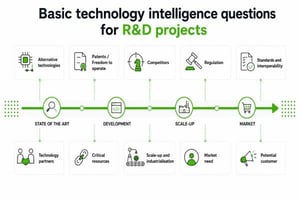
The state-of-the-art report is the starting point, not the end of the monitoring process. These...
In many corporations, technology scouting exists, but it is not always organised as a true corporate capability. Sometimes it appears in response to a specific challenge, a call for proposals, a meeting with the business, or a sudden interest in an emerging technology. Startups are then searched for, hubs are reviewed, some solutions are analysed, and promising conversations begin. The problem is that, once that urgency has passed, much of the knowledge identified becomes dispersed, the criteria change, and the process starts again almost from scratch.
The challenge for the person responsible for Open Innovation is not simply to find interesting technologies or players. It is to build a system that allows the organisation to monitor continuously, reduce noise, involve internal experts and turn external signals into useful decisions. That is where technology scouting stops being a one-off activity and starts to resemble an intelligence function.
So, before talking about tools or methods, it is worth clarifying what objectives an Open Innovation function in a corporate really pursues.
What intelligence objectives does an Open Innovation manager pursue?
When we talk about Open Innovation, it is easy to reduce the conversation to “finding startups or potential partners in academia”. But that simplification hides the real complexity of the role. An Open Innovation manager is not only looking for possible external collaborators: they must anticipate change, connect opportunities with business needs and prevent the company from arriving late to relevant moves in the environment.
1. Detecting emerging technologies before competitors
One of their most constant objectives is to detect in advance technologies, solutions or approaches that may open up new opportunities or threaten existing positions. It is not simply a matter of identifying what is new, but of distinguishing which developments deserve real attention and which are merely market noise.
2. Identifying startups, partners and relevant players in the innovation ecosystem
Open Innovation needs to engage with an external ecosystem: startups, universities, technology centres, suppliers, investors, accelerators and other players. The objective is not to accumulate contacts, but to identify who can add value according to the challenges and priorities of the corporate.
3. Reducing blind spots and building strategic optionality
Here we face two complementary and closely related objectives:
-
Minimising what “we were not monitoring because we did not know it existed”.
-
Creating and preserving options so that we can make better decisions when the environment changes.
Often the key value does not lie in finding an immediate opportunity, but in avoiding strategic blindness. Knowing that a technology is at a mid-level TRL or is maturing, that a startup has a credible technical foundation, or that a competitor is exploring a particular field already changes the position from which you make decisions.
4. Aligning external exploration with strategy, business and R&D
External exploration only adds value when it is connected to real priorities. If scouting operates in isolation, it may produce a collection of interesting findings that are not actually priorities. The key is to translate strategy and internal challenges into specific questions about the environment: which technologies to monitor, which players to follow, which changes could affect the business. In competitive intelligence, this framework of priorities is usually formalised in an Intelligence Directive.
5. Turning signals from the environment into useful decisions
The urge to monitor everything possible leads to infobesity and drastically reduces the chances of impact. The ultimate objective is not to monitor more, but to decide better: to open a conversation, launch an internal validation, prepare a pilot, discard a line of work or keep a radar active. At that point, scouting ceases to be “search” and becomes part of the company’s decision-making capability.
Seen in this way, the objectives of Open Innovation are far broader than a simple exploration of startups. And that explains why so many scouting initiatives fall short.
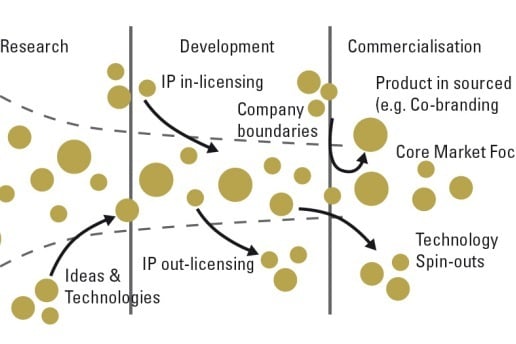 Osterwalder's open innovation model
The most common mistake: confusing technology scouting with specific searches
The problem with technology scouting is usually its organisation. Many companies activate it only when an urgent need appears: a business unit asks for references, a technical challenge arises, a call for challenges is being prepared, or management asks what is moving in a particular field.
The result is that each search begins almost from scratch, and the information sources are rebuilt depending on the initiative or the person involved. But the most important problem is that there are no prioritisation criteria based on the knowledge that already exists across the organisation. Experts from other teams are not directly involved in the process, and that deep-tech or business knowledge is completely underused when it comes to focusing attention.
It may also happen that the information gathered is never consolidated into knowledge and does not lead to a next step.
This type of scouting can generate useful results in the short term, but it rarely builds a corporate capability. What it leaves behind is not a radar, but a succession of disconnected efforts. And in an environment where technology, regulation and competitors move at different speeds, that discontinuity is costly.
Doing a search well once is not the same as monitoring well on an ongoing basis. We have already discussed this on this blog when we talked about the difference between a State-of-the-Art report and continuous technology watch.
That is why the important question is not whether you do technology scouting, but how you organise it.
How to organise a technology scouting process that is genuinely useful
Organising technology scouting well does not mean monitoring more sources or generating more alerts. Let us avoid information overload. It means designing a system with focus, criteria, roles and cadence. A system that allows you to detect what matters, distribute the analysis and connect the environment more effectively with innovation decisions.
1. Defining which technologies, markets and players are worth monitoring
Everything starts with defining the focus. If the organisation does not make explicit what it wants to know, scouting ends up being driven by shifting impulses. It is advisable to translate strategy and internal challenges into concrete monitoring hypotheses. These hypotheses should not be formulated as loose lists of technologies or actors, but as relevant combinations between them: a specific technology, applied to a market, observed in certain competitors, startups or regulatory frameworks. It is that combination that makes it possible to detect genuinely actionable signals. Thus, a focus on “hydrogen transport” multiplies its value if we cross it with competitor strategy, the evolution of private and public investment, and so on.
2. Selecting sources and ecosystems with clear criteria
Once the focus has been defined, you have to decide where to look, and build your reference universe. Not all signals arise in the same places. Some appear in sector media, others in scientific publications, patents, events, professional networks, startup portals, corporate websites or investment movements. The quality of scouting depends as much on the focus as on the architecture of sources. Expecting a marketing agency such as Google to apply the same criteria and priorities as your organisation is, at the very least, naive.
3. Establishing criteria to filter and prioritise signals
One of the biggest problems with scouting is that, without strategic guidance, it produces too much material and too little impact. That is why it is advisable to define from the outset what makes a signal relevant: novelty, applicability, maturity, strategic alignment, urgency, risk, scope for collaboration or potential impact on the business. To do this, the experts who have the ability to interpret key signals, for example in deep tech or business potential, must contribute their judgement. It may only be a few words, but it helps protect the company’s attention.
4. Distributing responsibilities between innovation, business and internal experts
Scouting should not fall entirely to a single person or team. Open Innovation may orchestrate it, but it needs support from experts in business, R&D, operations, quality, procurement or regulation. The foundations of a successful system lie in deciding who detects, who interprets, who prioritises and who decides the next step.
The more complex the corporate, the less sense it makes to have scouting centralised and isolated from the knowledge distributed across the organisation.
5. Creating a stable cadence of review and decision
Without rhythm and discipline, scouting becomes intermittent accumulation. A work routine is needed: periodic reviews of the metrics, sessions to review priorities, and keeping the focus areas up to date. The important thing is not only to capture information, but to prevent the process from stagnating and from falling behind the evolution of the company’s interests.
6. Reviewing and adjusting
The governance of a system is probably the great forgotten element in early-stage processes. A mature scouting system also needs governance: knowing which focus areas are working, where noise remains, which areas participate most, which deliverables are actually used, and which signals end up triggering action. Without that visibility, the process exists, but it does not improve.
It is essential to have metrics that are easy to obtain and useful for continuous improvement.
At this point, scouting starts to look less like a discontinuous search and more like a continuous intelligence function.
Why technology scouting needs to be supported by technology watch and competitive intelligence
In practice, technology scouting can rarely be assessed in isolation. An emerging technology matters not only because of its technical novelty. It matters because of its possible fit with the market, because of competitor movements, because of its maturity, because of regulatory barriers and because of the company’s real ability to turn it into a competitive advantage.
Technology scouting, technology watch and competitive intelligence are not the same thing, and they need one another. Technology scouting is usually associated with identifying external players, solutions and opportunities. Technology watch provides continuity in following technical developments and signals. Competitive intelligence adds the context of market, competition, customers, regulation and strategy.
A promising startup is not assessed only by its technology. A startup may have a brilliant proposition and yet not fit the business priority, the market timing or the internal capacity for adoption, or corporate culture. That is why scouting needs context, not just discovery.
The best decision emerges when you connect technology, market and organisation. Value appears when an external signal is interpreted from several functions within the company. That cross-reading makes it easier to distinguish between fashion, where technological experts are key, an interesting possibility, where business vision matters, and an actionable opportunity, where organisational fit is decisive.
That is why scouting creates more value when it is deployed within a continuous radar shared by several functional areas of the company.
Attention fatigue and the protection of expert time
One of the least visible costs of technology scouting is attention fatigue. When everything is interesting, nothing is a priority. And when too many signals reach too many people, internal experts stop paying attention. Infobesity creates exhaustion and inefficiency.
In most corporates, expert people with the judgement to interpret a signal cannot spend hours reviewing large volumes of information, whether relevant or not. That is why organising scouting also means protecting their time: channelling a smaller flow of information, but of better quality. Systems based on semantic analysis will provide us with higher-quality information.
To channel that flow, we can define expert people who curate information before it is broadly distributed, and others who are less directly involved or have less technical judgement, but who can still contribute valuable perspectives from other angles.
To improve quality, in addition to filtering content well, we can also rely on metadata, that is, information about the signal. A signal on its own is of little value if it is not clear why it has been filtered and why it is potentially relevant from the outset. It is useful to accompany scouting with context: which objective it responds to, its source and how that source is categorised, whether it is related to other signals about the same event, who in the team has already analysed it, and so on. All this information is managed in the metadata of each signal.
Another difference between mature and immature scouting lies in the ability to reuse knowledge and avoid organisational Alzheimer’s. When a corporate documents well what it detects, it avoids starting again from scratch every time a technology reappears or an area asks about it again.
A practical model for implementing a continuous technology scouting system
If your company wants to professionalise technology scouting within Open Innovation, it does not need to start with a complex deployment. It needs to start with a clear model. One that translates strategy into observation, observation into key information, and that into decisions.
Step 1. Translating strategy into monitoring focus areas
The questions say far more than the answers. The first step is to identify the questions that really matter, our intelligence hypotheses: which technologies could reshape our sector, what types of solution we are looking for, which external capabilities we are interested in exploring, and which risks we do not want to leave unmonitored. We will do this by relying on an Intelligence Directive.
Step 2. Activating a radar that generates key signals
From those focus areas, a radar is designed that combines different classes of sources and different types of actor: startups, competitors, universities, hubs, publications, events, funds, regulators or technology centres. The design of the radar must respond to the principles of the Intelligence Brief, and will probably have focus areas distributed across strategic intelligence and foresight.
Step 3. Distributing signals within the organisation for analysis
Useful information is best interpreted by those who have experience and context. Analysis must be assigned to whoever knows the business, the technology or the affected process. This is one of the points where a collaborative approach adds the most value.
Step 4. Prioritising and turning signals into actions or decisions
The process must separate what is merely interesting from what is truly relevant. That requires involvement. What is escalated to committee or evaluation, and what triggers concrete actions.
A well-organised scouting system does not end in a list. It ends in an action: contacting, exploring, discarding, monitoring, escalating or reviewing. If that final transition does not exist, scouting remains observation without impact.
At this point, it makes sense to ask what role a specialised platform can play in that process.
How a solution such as Antara Mussol can help
If a corporate wants to turn this approach into a sustainable practice, it needs not only judgement and processes, but also operational support that keeps the radar active, distributes signals and preserves accumulated knowledge.
A solution such as Antara Mussol is only a support for managing Open Innovation. It does not replace the relationship with startups, internal negotiation, the pilot or the final decision. But it can strengthen the hardest part to scale: maintaining a continuous, precise and shared radar over technologies, players and signals in the environment.
Defining more clearly what is being monitored
One of the first problems in scouting is ambiguity of focus, the indeterminacy of the hypothesis. When an organisation does not define precisely what it wants to monitor, the system fills up with non-specific information. And that volume of uninteresting information is noise. A solution such as Antara helps to structure those focus areas and keep them alive over time.
Monitoring heterogeneous sources continuously
Useful scouting does not live in a single startup database or a single information channel. It requires combining different, highly heterogeneous sources and following them continuously, not only when there is a specific initiative.
Filtering noise and distributing signals according to the right profile
Not everyone in the organisation needs the same information, nor at the same depth. Nor does everyone have the same analytical capacity on every subject. A specialised platform helps each profile receive what is relevant to them, with less friction and more context.
Turning dispersed information into shared intelligence
This is probably the most important shift: moving from dispersed signals to organised, traceable and reusable knowledge. When that happens, Open Innovation gains continuity and the corporate learns faster.
Antara does not replace the judgement or analytical capability of the Open Innovation team, nor its relationship with the innovation ecosystem. Its role is different: to help that judgement rest on a more continuous, shared and governable system, capable of turning dispersed information into useful intelligence for decision-making.
Integrating with your working environments
The monitoring process is not isolated from the rest of the functions, and there is always a need to connect the result of scouting with the working environments used by the Open Innovation team. Whether these are corporate information channels or project management software, Antara allows actions to be launched in those environments from the intelligence platform.
How to know whether your technology scouting is well organised
A good way to assess the maturity of technology scouting is to stop asking how many things you find and start asking how much organisational value you are capable of generating from them.
-
Are relevant signals arriving in time? If an opportunity is detected late, the problem is not the volume of information, but the system.
-
Is the percentage of noise still too high? If internal experts are receiving too many irrelevant signals, the model is eroding their attention.
-
Is the knowledge detected being shared, or is it remaining in silos? If each area starts its searches again separately, then there is still no true corporate capability.
-
Do signals end in decisions, or only in conversations? This is the decisive question. If scouting does not change priorities, conversations or actions, then it is still not sufficiently integrated into the organisation.
Conclusion
Technology scouting does not add value merely by finding startups, technologies or interesting trends. It begins to add real value when the corporate is capable of organising it as a continuous capability: with specific focus, involving the analytical capacity available, and with a real connection to decision-making. At that point, Open Innovation stops depending on occasional searches and begins to operate with a radar that learns, adjusts and improves over time.
In an environment where the speed of technological change coexists with information saturation, the advantage does not lie in seeing more things. It lies in seeing sooner the things that matter, understanding them better, and ensuring that they reach the people who can turn them into action.