
As a candidate for "northern adoption", I try to look Londoners in the face and say good morning....
Business foresight aims to reduce long-term uncertainty, so that we can make better strategic decisions today.
Decisions such as buying a company in the Brazilian market, building a factory in Poland, or divesting from one of our business areas will affect the course of our business 15 or 20 years ahead. What will our business be like then? And what will be our company’s fit in that market?
I have received some questions about the Scenario Planning method, and what seems to cause the most apprehension is developing the scenarios, because they are the furthest thing from the typical, boring internal memorandum used in companies. Some people even feel a bit embarrassed because of “what people will say”.
Precisely one of the keys to the success of business foresight according to the Scenario Planning method is the design of strategic scenarios.
Scenarios are possible visions of the world in the form of narratives that describe contexts.
Let’s look at an example, albeit simplified.
Scenarios are narratives: just as we learn from the past because someone tells us stories with cause-and-effect relationships, we could understand a possible future through a story that shows us those potential cause-and-effect relationships.
When we develop scenarios, we must bear in mind 5 keys or basic rules:
-
They must be plausible. But not predictable. They should include surprising elements.
-
They must be consistent. Both for the person who creates them and for the person who reads them.
-
Let’s give them a creative title. Nothing like “Scenario #1: Everything is going well in 2030.”
-
They are a story. A tale. About what the world is like in that future, and about what our organisation is like in that future.
-
They must be presentable in a 5-minute introduction. As if it were an elevator pitch.
I was looking for a business on which to develop an example, and I found it while reading the newspaper: “Contributions no longer cover the pensions pot.”
.jpg?width=448&height=329&name=el%20mundo%20-%20Pensiones%20(1).jpg) Source: El Mundo newspaper.
Source: El Mundo newspaper.
So, let’s suppose we are the Social Security system, and since our business is very (quite) long-term, our scenarios will have to look further ahead than those of a “typical” company, and therefore be quite risky. This will allow us to illustrate the objective more clearly. As we already know from the post Scenario Planning and Competitive Intelligence, before developing the scenario we must identify, classify and choose the “change drivers” or mechanisms of change that affect our business. Let’s assume that, after carrying out an expert analysis, we are going to work with two mechanisms of change in our scenario: robotisation in productive activity and trade union activity.
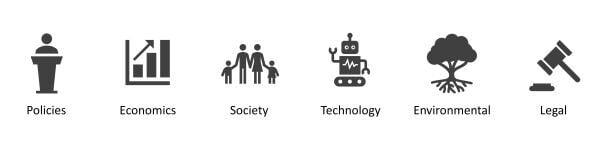 Classification of mechanisms of change in the PESTEL analysis.
Continuing with the scenario classification from the previous post, both have a potentially large impact on our business, and we do not know what long-term evolution they may have. The scenario is determined by the direction of the axes of each mechanism of change. In one case we will consider an exponential technological evolution, and in the second we will disregard the current trend towards freelancing and assume that trade unions continue to shape a possible political agenda.
Of the five keys presented above, the most difficult to achieve is the second: a scenario can be consistent for the person who creates it, but will it be for the person who reads it? So, I came up with something risky (because there was no going back): publishing the scenario as an article on LinkedIn Pulse, without giving any further explanation to the potentially surprised reader: Robotic dystopia and social security. Almost 30% of readers recommended it, despite it being a text out of place on that professional social network. Therefore, we can consider that this is a consistent text that meets the second key.
Scenarios must be reviewed to maintain their consistency over time, and therefore monitoring the evolution of the mechanisms of change, and their influence on the designed scenarios, will be a task to be carried out with the support of competitive intelligence and its digitisation.
Scenario Planning is to Competitive Intelligence what the Strategic Plan is to Innovation.
The subsequent evolution of scenarios must be based on information and analysis of environmental signals that strengthen or weaken that scenario. Articles such as Can you be replaced by a robot? should be included as references in future editions of the scenario. To detect the signals and develop the analysis of their impact, we will rely on software solutions in which we can model information hypotheses related to the mechanisms of change that we have chosen.
In designing scenarios you have to aim for the long term, although we will not reach 100,000 years into the future as in Werfel’s classic.
(The Star of the Unborn is a book written by Franz Werfel in 1931.)